White Nothe...
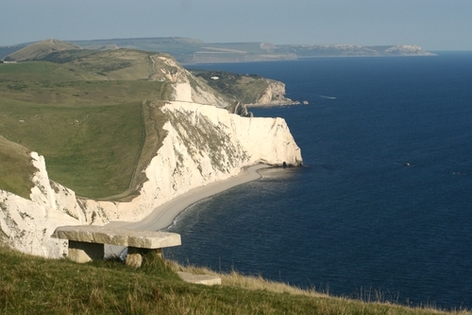
White Nothe is one of the Dorset Jurassic Coast’s best viewing points. Whilst not as high as Golden Cap nor as famous as Durdle Door, this cliff-top lookout has better views than the first, and a tranquility the second seldom achieves.
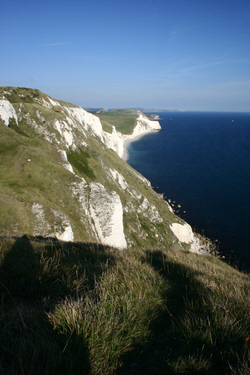
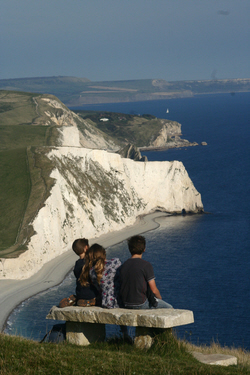
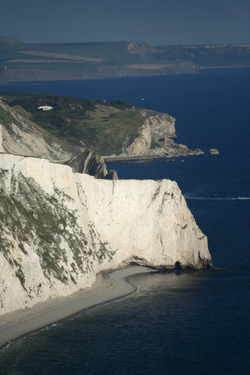
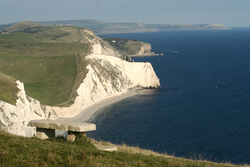
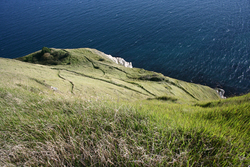
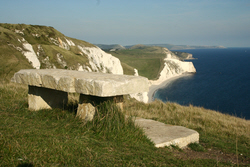
Part of the South West Coast Path, White Nothe is one of several amazing geological features those walking from Lulworth Cove to Ringstead or Weymouth can admire. But you don’t have to walk the whole section to enjoy it, as it is fairly easy to reach using paths from the top of Ringstead Hill or Ringstead Bay. The former is slightly closer, is National Trust land and has the advantage of being free parking whether you are an NT member or not! From Ringstead Hill, White Nothe is about a two and three-quarter mile round trip - so a comfortable stroll, but one which is not ideal for buggies or those with mobility issues. Whilst the first part of the journey is over farm track-ways, the remainder is pure field and cliff-top. The views from the latter are excellent, on a clear day. On days that are windy, wet or foggy, you might not want to be there at all as there’s nothing between you and France in one direction and the Americas in the other. Consequently it’s prone to being draughty and wet. The cliff-top section of path is narrow, but not perilously so, even though the drop to the seaward side is steep and in places near vertical. So it's worth treating the route with some respect, especially if the path is muddy or slippery. Of course, this close proximity to the very edge of Dorset, is what gives the path, and White Nothe, such impressive views. Looking West you’ll see Ringstead, Weymouth and Weymouth Bay. To the South and South West is the English Channel, more of Weymouth Bay and Portland. All of which is impressive, but the real gem is the view to the East. White Nothe itself is a fairly substantial chalk outcrop and cliff, which has a “Smugglers’ Path” meandering up its more grassy face for those sure-footed enough to try it. But it also provides a great view point Eastwards of the brilliant-white chalk cliffs of Bat’s Head and then on to the Portland Stone grey of Durdle Door. From White Nothe, the complete arch of Durdle Door can’t be seen, but its much smaller neighbour “Bat’s Hole” can. And from there on, there is layer after layer of interlinking background that just keeps on going past Lulworth Cove and all the way to St Aldhelms’s Head. On a clear day, it is truly a sight to see, and probably close to what most people imagine when they first hear of the “Jurassic Coast”. It has that rocky, prehistoric look about it. Which is slightly ironic given that the big fossil finds for which the Jurassic Coast is justly world-renowned have been made in softer, browner, and ever so slightly less magnificent, cliffs around Charmouth, Lyme Regis and Kimmeridge. Even so, there are things you will get from White Nothe that you won’t get from any of these others. The view is one. The sense of peace and tranquility is the other. Because White Nothe is miles from the nearest road, the only traffic noise you are likely to hear is the occasional boat passing in the sea below or any air traffic passing overhead. Presumably, if the ranges at Lulworth are active there’s likely to be a bit of distant gunfire, but if not, this is a great place to sit and forget about the 21st Century. So turn off your phone and enjoy the sound of the wind, the sea far below and not a lot else other than birdsong. Whether you take in White Nothe as part of a full-scale assault on the whole South West Coast Path; or part of a more modest and practical attack on this part of it; or even just as a Sunday afternoon diversion for you and the kids, you’re unlikely to be disappointed, provided the weather doesn’t let you down. This is a great spot. And like many a “great spot”, you probably won’t spend very long once you get there. Perhaps long enough for a sandwich and a “Thermos”. Certainly it is one of those places you will spend more time in getting to and from it than you will on actually being there. But it is also a place that you will remember reaching and seeing long after you have forgotten how you got there. If you decide to go, pick your day if you can, whether walking as part of a ramble or dawdling as part of an afternoon amble. Good weather will make all the difference, allowing as it does clear views from one horizon to the other. |
This is a great spot. And like many a “great spot”, you probably won’t spend very long once you get there. Perhaps long enough for a sandwich and a “Thermos”. "
|