Corfe Castle...
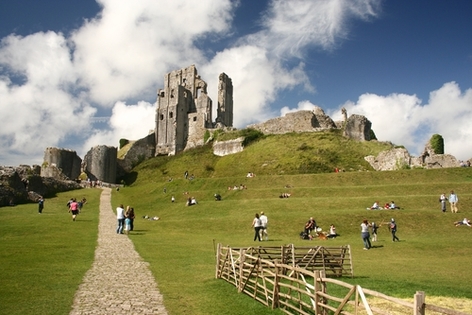
Corfe Castle is a fascinating and beautiful place that will fire your imagination as well as your sense of history.
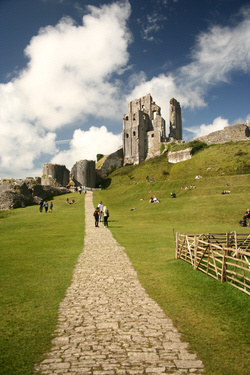
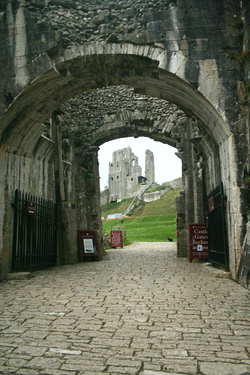
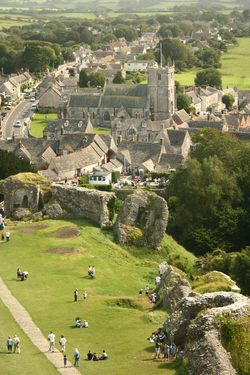
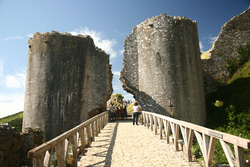
The Castle itself is larger-than-life and until you see it, you wouldn’t believe it. Even then, you’d be forgiven for thinking it was a massive fibreglass film set or a 19th Century folly. But there’s nothing fake about Corfe Castle or the picturesque Dorset village that sits at its base. What’s more, Corfe Castle has a story to tell of conflict and destruction that is intertwined with the way in which Britain is governed today. Corfe is one of those rare phenomena, a man-made structure that dominates the landscape for miles around and yet sits perfectly at ease within it. Corfe and the landscape merge seamlessly into one, with each richer and more beautiful for the presence of the other. They’ve had plenty of time to get acquainted. The Castle, of motte and bailey design, is around 1,000 years old, having been built in stages by the Normans after William did his conquering at Hastings in 1066. The castle was sited to protect routes through the Purbeck Hills from the coast into the rest of Dorset. And it did a good job until 1646. During the English Civil War between the forces of King Charles and those of Parliament, the Royalist Lady Bankes used Corfe Castle as a stronghold. She successfully held the castle against a siege in 1643, but in 1646 when the Parliamentarians returned for a rematch, Lady Bankes and the castle were betrayed by one of their own. The Parliamentary soldiers were let in by stealth and Corfe’s substantial and imposing defences bypassed. This, no doubt, was a source of considerable irritation to Lady Bankes, but worse was to come. The Parliamentarians, having been stumped by Corfe Castle on two occasions, were in no mood to see it happen again. Having captured the castle intact, they set to work blowing it to pieces! Whether this act of seemingly senseless vandalism was petulance on their part or a show of strength to discourage others from standing in the way of Parliamentary democracy, who can tell. But it is on events such as these that the foundations of the Parliamentary system we have today were formed (which is a little scary!). The gunpowder demolition of Corfe Castle by the Parliamentarians is what gave us the magnificent ruins we see to today. Whether it is a testament to the quality of the original building or the limitations of 1640’s explosives, much of the structure remains and is still clearly identifiable as a castle. Being a National Trust property, you can wander around Corfe Castle for free if you’re a Member, but will need to pay an entry fee if you’re not. The reward for the fee is the chance to touch 1,000 years of history and to look out on wonderful views considerably older than that. Even on a cloudy day in January (as some of our pictures show) these are quite impressive, but in fair weather they are amazing. You don’t need to pay the entrance fee to see Corfe Castle. The truth is you can see it for miles around, but it’s only by being there and looking down at the countryside and villages around that you truly appreciate the scale of the building, the thickness of the walls and the command that it would have had over the surrounding lands and people. It is then much easier, even as a ruin, to appreciate the military and political significance of a castle like Corfe and why some people wanted it there and some people didn’t. Its capture by betrayal and explosive destruction must have sent a powerful, visual and no doubt audible message that spread far beyond the confines of Corfe and the Purbecks. As well as wider views, Corfe Castle is also an ideal place to look down on Corfe village. Built with local Purbeck stone, including some reclaimed by resourceful locals from the destruction of the castle, this is an interesting place to visit in itself. Corfe has its own station as part of the Swanage Steam Railway and numerous picturesque cottages with characteristic stone roofs. There are also pubs, eateries and tea shops, including one with an excellent outdoor model of Corfe Castle as it would have appeared before it was blown up. This comparatively large-scale model is in a beautiful garden overlooked by the castle itself. This gives added perspective to both and is well-worth a visit and the small fee to get in. Corfe also has a traditional sweet shop, selling confectionary from jars alongside newspapers and other essentials for tourists and locals alike. It’s just the place to go for sherbet lemons and pear drops. If, as you hear the sweets clatter into the weigh-scales you get a sense of being in another time, back not 1,000 years, but in your own childhood, don’t be surprised. It may be the sights, sounds and smells, or it may just be that a visit to Corfe can make you feel like a character in a children’s book. If it does, it may be coincidence, but more likely it will be because Enid Blyton, who visited the area often, used it as the setting for some of her fictional adventures of “The Famous Five”. These days, Corfe is not the sleepy place it might once have been, especially during the high season. It can get busy and if you have small children you’ll want to keep them under close control as, in places, the pavements are quite narrow and run alongside the main road from Wareham to Swanage. There’s ample parking just outside the village at the visitor centre and more if you go through the village itself. Alternatively you can make the best of your day out by parking at the Norden Park and Ride and taking the train the short hop to Corfe. Corfe and Corfe Castle are great places to spend a day anytime of the year and if, on your way home you have some time to spare, why not call in at the lost village of Tyneham. |
Corfe is one of those rare phenomena, a man-made structure that dominates the landscape for miles around and yet sits perfectly at ease within it."

Click for information from the National Trust's website
|